By Luke Forrester — Teacher at La Casita de Inglés and author of the Casita Method educational series. BA (Hons) in Psychology, University of British Columbia.
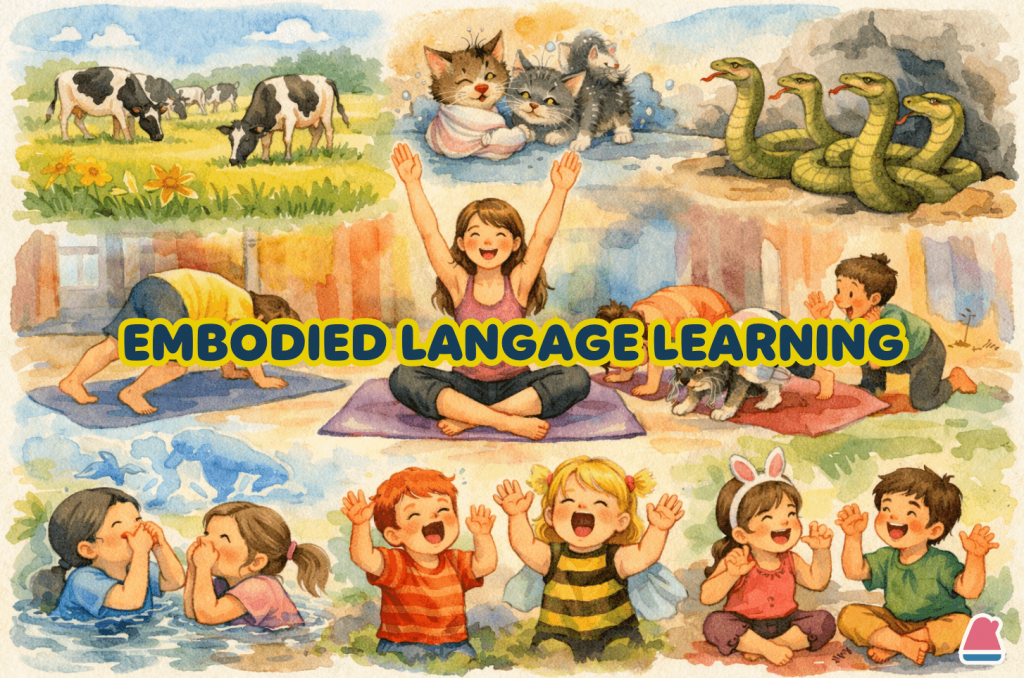
A herd of cows peacefully grazes on a sunny field, mooing in delight at all of the fresh grass.
A litter of cats curves their back at the shock of an unwanted bath.
A den of snakes rear their necks off the ground, ready to strike!
«Now reach all the way up to the sky like a tall, hungry Giraffe!» I announce from my yoga mat, demonstrating the move to my 3- and 4-year-old Bumblebees. In the course of our animal-themed yoga session, the theatre room has transformed into a zoo of wild beasts (frankly, it doesn’t take much imagination).
«Woof woof!» Calls out one of my students, moving into a position that they must know is a «downward dog.»
«Good job!» I say, copying their movements and barking along. Today we’re learning about the difference between pets and farm animals, and I think it’s starting to click. After a few more deep breaths like whales coming up for air, we let out a lion’s roar in lieu of «Namaste.»
With smiles on their faces and limber little muscles, these little ones are just along for the ride; they might not understand why their teacher is howling at the moon in a criss-crossed yoga pose, but they like it.
Yet, as always with La Casita de Inglés, there’s a method behind the madness.
Embodied Learning is More Fun and Memorable for Kids
Traditional teaching and learning models often operate based on the idea that children learn best when they’re sitting down. In theory, they can listen and learn better without being distracted by movement- the assumption being that learning only takes place in the mind.
And yet, on the most fundamental level, children learn by interacting with their environment and the people within it. A baby learns that falling down hurts when they’re trying to walk, long before they can understand the language behind their parents’ panicked warnings. Another example: we learn to ride bikes by riding a bike– not by sitting in a classroom to hear a lesson about balance and pedalling.
In fact, there is an established link between children’s development of gross motor skills (like balance, coordination, walking, dancing, and more) and their language development (Gonzalez et al. 2019). As infants learn to walk, they gain new ways to interact with their environment, discovering new objects, people, and feelings that need labelling with new vocabulary (Walle & Campos, 2014). Motor developments also correspond with children’s growing social skills as they learn to appreciate the ideas of cause and effect (i.e. If I reach up and push over this expensive vase, it will fall and mummy will be upset!).
Language and movement are neurologically linked, too. A small region at the back of the brain called the cerebellum uses some of the same wiring to control both physical coordination and language processing (Stoodley & Stein, 2011). Moreover, the sensorimotor cortex (the movement and sensation control centre) lights up one way when we are reading nouns or viewing objects, and a different way when we are reading verbs or watching actions (Horoufchin et al., 2018). In other words, the brain networks that take care of our physical movements are key to processing the language of movement as well!
Learning, Doing (and Mooing) at La Casita
Based on these insights, the approach of embodied learning at Casita is all about incorporating movement, gestures, and hands-on experimentation into the classroom. We might learn counting from throwing bean bags, fairytales from acting out plays, or animal words from striking wonky yoga poses and mooing like a cow. We use recognizable gestures to demonstrate vocabulary as a cornerstone of the total physical response teaching method, which helps kids of all ages understand what us teachers are blabbing about even when they know very little English.
We do this because it works. Embodied learning has been shown to help primary school children pick up new and difficult vocabulary words, alongside making class a lot more fun and motivating for them (Kosmas & Zaphiris, 2020). In particular, using embodied learning improves kids’ memory for new foreign language words over and above the «traditional» sit-and-learn sedentary style (Schmidt et al., 2019).
At La Casita de Inglés, our theatre and dance rooms are designed for this exact kind of movement-based embodied learning. In the Home Circle rotation, these rooms transform into multipurpose disco-halls, obstacle courses, theatre stages, and animal farms. Our kids of all ages learn by doing, all while improving important (and related!) gross motor skills like balance, coordination, and body-awareness.
The ideas of embodied learning are also easy to try out when practicing English with your little ones at home! Maybe you extend your arms out and drive an imaginary steering wheel when you are going somewhere in the «Car.» Maybe you clasp your hands next to your ear and tilt your head when you explain that you’re «tired.» Maybe you cover your ears every time you need a little «quiet.» And maybe, best of all, you cross your thumb and index finger to make a heart (as seen in KPop Demon Hunters) every time you say: «I love you.»
When it comes to La Casita de Inglés, every stretch, roar, and wonky yoga pose is a reminder that the best learning happens when our minds, bodies, and imaginations are moving together.
References
Gonzalez, S. L., Álvarez, V., & Nelson, E. L. (2019). Do gross and fine motor skills differentially contribute to language outcomes? A systematic review. Frontiers in Psychology, 10, Article 2670. https://doi.org/10.3389/fpsyg.2019.02670
Horoufchin, H., Bzdok, D., Buccino, G., Borghi, A. M., & Binkofski, F. (2018). Action and object words are differentially anchored in the sensory motor system: A perspective on cognitive embodiment. Scientific Reports, 8, Article 6583. https://doi.org/10.1038/s41598-018-24475-z
Kosmas, P., & Zaphiris, P. (2020). Words in action: Investigating students’ language acquisition and emotional performance through embodied learning. Innovation in Language Learning and Teaching, 14(4), 317–332. https://doi.org/10.1080/17501229.2019.1607355
Schmidt, M., Benzing, V., Wallman-Jones, A., Mavilidi, M.-F., Lubans, D. R., & Paas, F. (2019). Embodied learning in the classroom: Effects on primary school children’s attention and foreign language vocabulary learning. Psychology of Sport and Exercise, 43, 45–54. https://doi.org/10.1016/j.psychsport.2018.12.017
Stoodley, C. J., & Stein, J. F. (2011). The cerebellum and dyslexia. Cortex: A Journal Devoted to the Study of the Nervous System and Behavior, 47(1), 101–116. https://doi.org/10.1016/j.cortex.2009.10.005
Walle, E. A., & Campos, J. J. (2014). Infant language development is related to the acquisition of walking. Developmental Psychology, 50(2), 336–348. https://doi.org/10.1037/a0033238