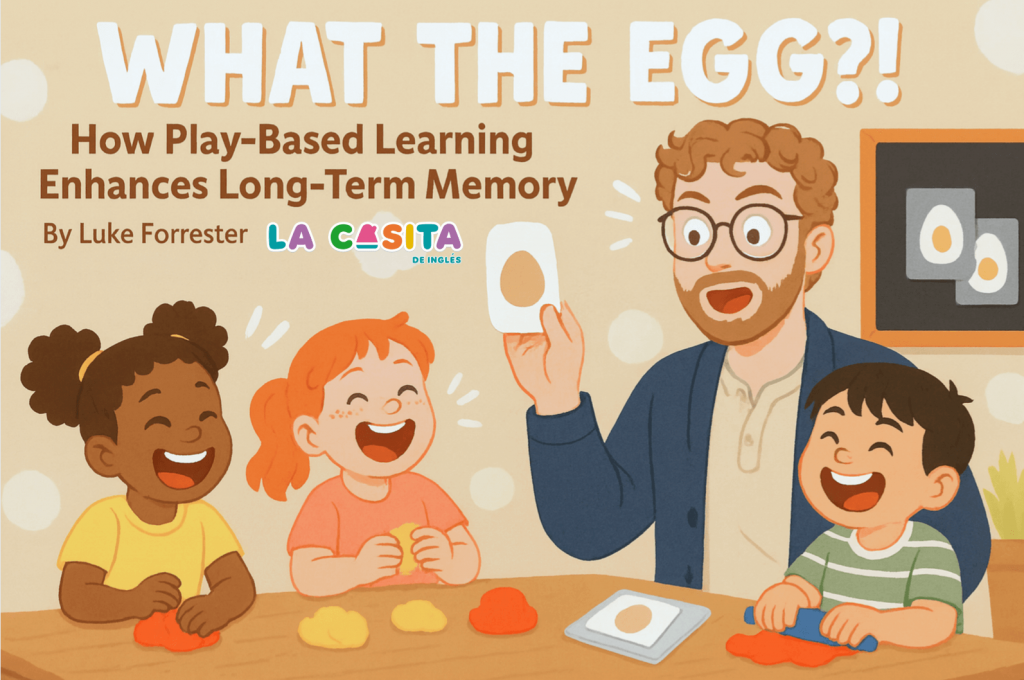
“What the EGG!?” screamed one of my 5-year-old students, to a chorus of belly laughter around the games table.
“What the EGG!?” I replied, holding up two piles of laminated egg printouts sorted according to size. They’re getting silly and a bit tired, I thought, better to let them get the giggles out. We each took turns yelling about eggs, laughing, until we were all finally ready to focus on the incredibly serious task of making our favourite meals out of playdough.
It was one of those La Casita moments that filled the hallways with the music of childhood, a tune familiar to all of us though all-too-often inaccessible in our stressful adult worlds. I was delighted, and frankly, I thought about it all night.
But a couple weeks later, that brief interaction had faded into the obscurity of my long-term memory, beat out for attention by the excitement and focus demanded of our monthly cooking week. There was a palpable electricity in the murmurings of my Hunny Bunnies, with one word standing out from all of the rest: “Cupcakes!” We were off to a great start, discussing all of the ingredients, chanting and counting our mixing song, and smiling all around the table.
As I brought out each ingredient, our conversation went a little bit like this:
Me: “Add the vanilla!” Class: “Add the vanilla! Me please!”
Me: “Can I add the oil?” Class: “Can I add the oil?”
Me: “Please can I add the milk?” Class: “Please can I add the milk?”
Me: “Please can I add the-” Class: “PLEASE CAN I ADD THE EGG!” [Cue giggles]
How do they all remember the word for egg?? I thought, That was two weeks ago!
The child’s brain can be a wonderfully mysterious machine, but for the curious parents out there, science can tell us a bit about why this class of Hunny Bunnies will probably remember eggs forever.
Memory in a Nutshell
Memory itself is a survival mechanism; it evolved in our species from our need to remember the things that have the potential to hurt us, which is why so many people are born with a fear of snakes, spiders, bears, or other potentially lethal creatures (Tyng et al., 2017). When you eat something that gives you food poisoning, chances are it will only take that one event for you to be put off that food for a longggg time.
But eggs are not dangerous wild animals. My hunny bunnies aren’t afraid of eggs. Eggs are just… Eggs.
The thing is, the part of our brain- the amygdala- that activates when we’re afraid of something, also fires up when we’re experiencing intensely positive emotions (McGaugh, 2004; Qasim et al. 2023). Have you ever watched a movie so scary that it almost made you laugh?
Essentially, our bodies are flooded with adrenaline when we experience big emotions, good or bad. Our nervous system picks up on the change of hormones in our blood stream, and sends messages back to the brain- in particular the amygdala and hippocampus- to encode the object of our attention into our long-term memories (Szeska et al., 2025).
It’s Easier to Remember Emotional Experiences
What do you remember better- the first time you fell in love, or trigonometric functions from your high school algebra class?
Hindsight is 20/20 – you may realize now that the first time you fell in love was more important because you remember it years later. But that doesn’t mean that when we were teenagers, we weren’t consciously trying to remember those pesky formulas for “the slope of the tangent line when sin-theta equals blah-blah-blah”…. The fact is, our emotional brain (e.g. the amygdala) probably didn’t care about those equations, even if our thinking brain (e.g. the prefrontal cortex) did.
In other words, our brain uses the biology of emotion to figure out what’s important to automatically remember (Qasim et al., 2023). When they belly laughed at “What the EGG!?” my Hunny Bunnies may have been unwittingly priming their brains to transfer that vocabulary into their long-term memories (Kralova et al., 2022). This is exactly why La Casita’s play-based, interactionist learning model is so effective; it makes language-learning an emotionally rich experience, so that it can become more automatic (and fun) for our students!
La Casita’s Approach to Learning
Kids learn how to speak their native language naturally because it’s the vehicle with which they’re experiencing and interacting with other people in the world- at Casita, we mimic that same process with English! By fostering belly laughs and social play instead of effortful, individualized repetition, we’re avoiding the same problem you (probably) encountered with trigonometric functions. We’re making use of the automatic mechanisms in our brain that make language-learning far easier to motivate in young learners.
Here’s a thought: why not begin to associate English with your kids’ favourite things? When they’re laughing, screaming, jumping for joy- that’s the perfect time for some English vocab! Are you riding a rollercoaster? Scream “I’m scared”! Are you cheering on your favourite soccer team? “Let’s go”! Did a new episode of KPop Demon Hunters just drop? “I can’t wait!”
Small, frequent moments like these will not only boost your child’s memory, but will also show them that English isn’t just something to be studied, memorized, and perfected for grades. Before you know it, their English skills will start to hatch (see what I did there?) all on their own.
Luke Forrester is a native English speaking teacher at La Casita de Ingles Poblenou. He’s also a dancer, poet, blogger, and language-learning enthusiast! Learn more about our teachers here.
Afterword:
Welcome! If you’re new to the Casita de Ingles family and curious about trying one of our classes for free, click here to register. We hope to meet you soon!
References:
Kralová, Z., Kamenická, J., & Tirpáková, A. (2022). Positive emotional stimuli in teaching foreign language vocabulary. System, 104, 102678. https://doi.org/10.1016/j.system.2021.102678
McGaugh, J. L. (2004). The amygdala modulates the consolidation of memories of emotionally arousing experiences. Annual Review of Neuroscience, 27, 1–28. https://doi.org/10.1146/annurev.neuro.27.070203.144157
Qasim, S. E., Mohan, U. R., Stein, J. M., & Jacobs, J. (2023). Neuronal activity in the human amygdala and hippocampus enhances emotional memory encoding. Nature Human Behaviour, 7(5), 515–525. https://doi.org/10.1038/s41562-022-01502-8
Szeska, C., Ventura-Bort, C., Giraudier, M., & Weymar, M. (2025). A vagal route to memory: Evidence from invasive and non-invasive electrical vagus nerve stimulation studies and areas for future clinical application. Frontiers in Human Neuroscience, 19, 1595737. https://doi.org/10.3389/fnhum.2025.1595737
Tyng, C. M., Amin, H. U., Saad, M. N. M., & Malik, A. S. (2017). The influences of emotion on learning and memory. Frontiers in Psychology, 8, 1454. https://doi.org/10.3389/fpsyg.2017.01454